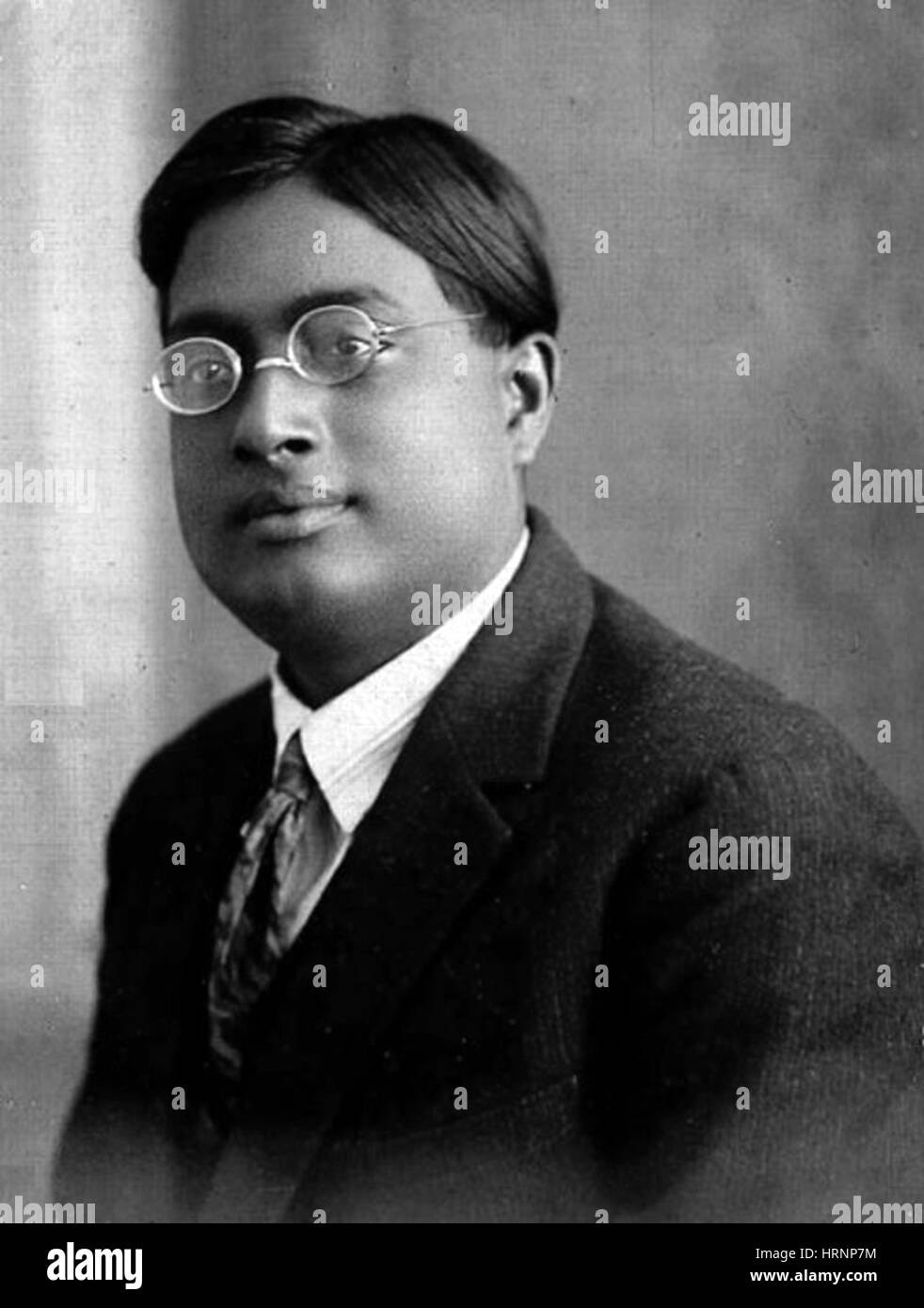
Satyendra Nath Bose
 India
Indiaวันเกิด
January 1, 1894
ราศี
Capricorn
สถานที่เกิด
Kolkata, India
อายุ
เสียชีวิตเมื่ออายุ 80 ปี
เกี่ยวกับ
Satyendra Nath Bose was an Indian theoretical physicist and mathematician whose work in the early 1920s reshaped quantum mechanics. He developed Bose-Einstein statistics, a framework that describes how particles like photons behave, and laid the groundwork for the Bose-Einstein condensate, a state of matter observed at near-absolute-zero temperatures. Physicist Paul Dirac named the class of particles that follow these rules bosons in his honor.
Bose was elected a Fellow of the Royal Society and received the Padma Vibhushan, India's second-highest civilian award, in 1954. A polymath with interests spanning physics, mathematics, chemistry, biology, philosophy, and music, he also served on national research committees after India's independence. He died on February 4, 1974, in Kolkata, leaving a legacy that continues to influence modern physics.
ชีวิตช่วงต้นและภูมิหลัง
Satyendra Nath Bose เกิดเมื่อวันที่ 1 มกราคม ค.ศ. 1894 ในกัลกัตตา เป็นบุตรคนโตจากทั้งหมดเจ็ดคน บิดาของเขา Surendranath Bose ทำงานเป็นนักบัญชีให้กับ East Indian Railway ก่อนที่จะเริ่มบริษัทเคมีและเภสัชกรรมของตนเอง มารดาของเขา Amodini Devi ดูแลครอบครัวชนชั้นกลางที่ให้ความสำคัญกับการศึกษาแบบอังกฤษ
ความอัจฉริยะของ Bose ปรากฏให้เห็นตั้งแต่เด็ก ที่โรงเรียน Hindu School ในกัลกัตตา ครูคณิตศาสตร์ของเขา Upendralal Bakshi ตระหนักถึงความสามารถพิเศษของเขา Bose เคยได้คะแนน 110 จาก 100 ในข้อสอบคณิตศาสตร์ด้วยการแก้ปัญหาหลายวิธี เขาสอบผ่านข้อสอบเข้าศึกษาต่อในปี 1909 โดยได้อันดับที่ห้าจากผู้สมัครทั้งหมด ที่ Presidency College กัลกัตตา เขาได้รับปริญญาตรีวิทยาศาสตร์สาขาคณิตศาสตร์ผสมในปี 1913 โดยสำเร็จการศึกษาเป็นอันดับหนึ่งของชั้นเรียน เขาศึกษาต่อที่ University of Calcutta ซึ่งคะแนนสอบปริญญาโทสาขาคณิตศาสตร์ผสมในปี 1915 ของเขาสร้างสถิติที่คงอยู่หลายปี
หลังจากสำเร็จการศึกษาระดับปริญญาโท Bose เริ่มงานวิจัยที่ University of Calcutta ในปี 1916 โดยมุ่งเน้นที่ทฤษฎีสัมพัทธภาพ เขาสอนที่ University of Dacca เริ่มตั้งแต่ปี 1921 ซึ่งเขาจะสร้างความก้าวหน้าครั้งสำคัญ
ความก้าวหน้าในอาชีพ
ในปี 1924 ขณะเป็นอาจารย์ที่ University of Dacca Bose เขียนบทความชื่อ Planck's Law and the Hypothesis of Light Quanta เขาได้กฎการแผ่รังสีควอนตัมของ Planck โดยใช้วิธีการนับสถานะแบบใหม่สำหรับอนุภาคที่เหมือนกัน โดยถือว่าอนุภาคเหล่านี้แยกแยะไม่ได้ เมื่อไม่สามารถตีพิมพ์ได้ เขาจึงส่งบทความไปให้ Albert Einstein ซึ่งตระหนักถึงความสำคัญของมัน แปลเป็นภาษาเยอรมัน และส่งไปยังวารสาร Zeitschrift für Physik ผลงานนี้กลายเป็นรากฐานของสถิติโบส-ไอน์สไตน์
Einstein ขยายแนวคิดของ Bose ไปสู่สสาร โดยทำนายคอนเดนเสทโบส-ไอน์สไตน์ ซึ่งเป็นสถานะของสสารที่ได้รับการยืนยันจากการทดลองในปี 1995 ในปี 1926 Bose กลายเป็นหัวหน้าภาควิชาฟิสิกส์ที่ Dhaka University เขากลับมาที่ Calcutta University ในปี 1945 ซึ่งเขาสอนและวิจัยจนกระทั่งเกษียณในปี 1956 นอกจากนี้เขายังสอนชั้นเรียนระดับบัณฑิตศึกษาเกี่ยวกับทฤษฎีสัมพัทธภาพเป็นภาษาเบงกาลี เพื่อส่งเสริมการศึกษาวิทยาศาสตร์ในภาษาท้องถิ่น
หลังจากอินเดียได้รับเอกราช Bose ดำรงตำแหน่งในคณะกรรมการวิจัยและพัฒนาระดับชาติต่างๆ เขาได้รับการเสนอชื่อเข้าสู่ Rajya Sabha ซึ่งเป็นสภาสูงของรัฐสภาอินเดียในปี 1958
ไทม์ไลน์อาชีพ
ภาพลักษณ์สาธารณะและสไตล์
Bose ได้รับการยกย่องอย่างกว้างขวางว่าเป็นอัจฉริยะที่ถ่อมตนและไม่โอ้อวด เขาไม่ค่อยแสวงหาความดีความชอบสำหรับผลงานของเขาและเป็นที่รู้จักในการลดทอนคุณค่าของการมีส่วนร่วมของตนเอง เพื่อนร่วมงานบรรยายว่าเขาเป็นคนเข้าถึงง่ายและใจกว้างกับเวลา เขาเป็นผู้สนับสนุนอย่างแข็งขันในการศึกษาวิทยาศาสตร์เป็นภาษาเบงกาลี โดยเชื่อว่าความรู้ทางวิทยาศาสตร์ควรเข้าถึงได้สำหรับทุกคน ภาพลักษณ์ของเขาในอินเดียคือวีรบุรุษของชาติที่นำวิทยาศาสตร์อินเดียขึ้นสู่แผนที่โลก และเขาถูกจดจำในฐานะสัญลักษณ์ของความอ่อนน้อมถ่อมตนทางปัญญาและการอุทิศตน
ชื่อเสียงและแฟนด้อม
Satyendra Nath Bose commands a global audience defined by academic reverence rather than popular celebrity, with his name recognized primarily within the scientific community and among history enthusiasts. The iFANN Global Fame Engine evaluated this figure in August 2026 and determined that Satyendra Nath Bose is currently unranked on the Global Top 1,000 list or any scope-specific top-100 charts, meaning no placement number applies to his current standing. While he remains a towering historical figure, he does not hold a specific ordinal position in the published rankings at this time. His legacy is sustained through institutional memory and the enduring study of quantum mechanics rather than modern fan metrics. Regarding his audience, there is no documented fandom name; the group of admirers consists of physicists, mathematicians, and students who engage with his work through academic channels rather than as an organized fanbase with a specific moniker. No rituals, campaigns, or social media movements are associated with him, reflecting his status as a scholar from a pre-celebrity era whose influence is measured in citations and scientific breakthroughs rather than public adulation.
เรื่องน่าสนใจและตำนาน
Satyendra Nath Bose was a polymath with deep interests in chemistry, biology, mineralogy, philosophy, arts, literature, and music. He could recite poetry in multiple languages and played the violin. He was known for his humility and often said he did not consider himself a genius. Rabindranath Tagore dedicated his only science book, Visva-Parichay, to Bose in 1937. Bose also campaigned for Hindi to replace English as the language of science in India. A central pillar of his legend is the incident where he sent a paper on quantum statistics to Albert Einstein after facing rejection from European journals. Einstein recognized the brilliance of the work, translated it into German himself, and submitted it to Zeitschrift für Physik, an event that led to particles following these rules being named bosons. Another poignant story from his life involves his reaction to Einstein's death; accounts state that Bose was so shattered by grief that he tore up an unpublished research paper. This anecdote highlights the profound personal bond between the two scientists and serves as a narrative illustrating Bose's character and loyalty.
คำพูดที่โดดเด่น
“I do not consider myself a genius. I only followed my curiosity.”
“Science should be taught in the language of the people.”
“The joy of discovery is the greatest reward.”
“Einstein's recognition of my work gave me the confidence to continue.”
“I never aimed for fame; I aimed for understanding.”
ครอบครัวและชีวิตส่วนตัว
Bose แต่งงานกับ Ushabala Bose (หรือที่รู้จักในชื่อ Ushabati Ghosh) ในพิธีแบบเบงกาลีดั้งเดิม ทั้งคู่มีลูกเก้าคน แม้ว่าหลายคนจะเสียชีวิตในวัยทารก บิดาของ Bose คือ Surendranath เป็นนักบัญชีที่ต่อมาดำเนินธุรกิจเคมี มารดาของเขา Amodini Devi เป็นแม่บ้าน Bose เติบโตในครอบครัวชนชั้นกลางในกัลกัตตากับพี่น้องหกคน เขาเป็นที่รู้จักในฐานะคนรักครอบครัวที่อุทิศตน ซึ่งสร้างสมดุลระหว่างงานวิทยาศาสตร์กับเวลาที่บ้าน
ความเชื่อมโยงที่โดดเด่น
Satyendra Nath Bose มีความสัมพันธ์ใกล้ชิดกับ Albert Einstein ผู้สนับสนุนบทความของเขาในปี 1924 และร่วมพัฒนาสถิติโบส-ไอน์สไตน์ Paul Dirac เป็นผู้บัญญัติคำว่า 'bosons' เพื่ออธิบายอนุภาคที่ปฏิบัติตามสถิติดังกล่าว Rabindranath Tagore ซึ่งเป็นเพื่อนครอบครัว อุทิศหนังสือวิทยาศาสตร์ของเขาให้กับ Bose ครูคณิตศาสตร์ของเขา Upendralal Bakshi ตระหนักถึงความอัจฉริยะของเขาตั้งแต่เด็ก และ Sir Asutosh Mookerjee ในฐานะอธิการบดีของ Calcutta University สนับสนุนอาชีพการวิจัยของเขา
ความสัมพันธ์และประวัติการคบหา
สตเยนทรา นาถ โบสแต่งงานกับอุชาบาลา โบส (หรือที่รู้จักในชื่อ อุชาบาตี โกช) ในพิธีแบบดั้งเดิมในช่วงต้นทศวรรษ 1910 การแต่งงานเป็นความสัมพันธ์ที่มั่นคงและสนับสนุนซึ่งกันและกัน อุชาบาลาดูแลบ้านและเลี้ยงดูลูกทั้งเก้าคนในขณะที่โบสทำงานวิชาการ เธอได้รับการบรรยายว่าเป็นภรรยาที่ทุ่มเทซึ่งสนับสนุนงานวิทยาศาสตร์ของเขา โบสแต่งงานกับเธอจนกระทั่งเสียชีวิตในปี 1974 ไม่มีบันทึกเกี่ยวกับความสัมพันธ์โรแมนติกอื่นใด
- แต่งงานแล้วUshabala Bose1914 - 1974การแต่งงานแบบดั้งเดิมของเบงกอล เธอสนับสนุนอาชีพของเขาและเลี้ยงดูลูกทั้งเก้าคน
การเสียชีวิตและผลที่ตามมา
เสียชีวิต
February 4, 1974 (อายุ 80 ปี)
สถานที่เสียชีวิต
Calcutta, West Bengal, India
สาเหตุการเสียชีวิต
เสียชีวิตตามธรรมชาติจากความชรา
Satyendra Nath Bose spent his final years in Calcutta, maintaining his academic interests and family life until the natural decline of advanced age took its toll. He passed away on February 4, 1974, within the city that had been his home for decades, marking the end of a life dedicated to theoretical physics and mathematics. The circumstances surrounding his death were reported as peaceful and natural, with no specific acute illness, accident, or foul play documented by authorities or biographical sources. His passing occurred without a public hospitalization immediately preceding the event, suggesting he died in a private setting consistent with the privacy norms for senior academics in India during that era.
The scientific community and government officials responded to his death with profound tributes rather than legal inquiries or investigations. While the funeral was conducted as a private affair following Hindu cremation rites, the legacy of the physicist was cemented through institutional memorials and continued recognition by the state. The Indian government established the Bose Institute in his honor, and his contributions remain celebrated annually on National Science Day. In recent decades, his name has appeared in educational materials and news regarding quantum physics breakthroughs, including references to the creation of Bose-Einstein condensates in the mid-2020s.
Posthumous honors included the naming of the subatomic particle boson after him and the enduring status of Bose-Einstein statistics as a foundational theory. A new book by his student Partha Ghose released around May 2024 highlighted their relationship and Bose's grief over Einstein's death, adding to the literary legacy. No major commercial films were produced solely about his death, though his name frequently appears in discussions of quantum mechanics.
มูลค่าทรัพย์สิน (มูลค่ามรดก)
$1 Million
การประเมินโดยทีมบรรณาธิการ iFANN
As a theoretical physicist and academic, Satyendra Nath Bose did not accumulate significant personal wealth. Per iFANN's editorial analysis, his net worth at the time of his death in 1974 is estimated at $1 Million in 2026 terms, primarily consisting of his academic salary, modest savings, and a small pension. He lived a simple life, dedicating his resources to his family and research. Posthumously, his legacy has not generated substantial estate income, though his name is honored through institutions like the S. N. Bose National Centre for Basic Sciences.
รางวัลที่ได้รับ (2)
สตเยนทรา นาถ โบสได้รับปัทมวิภูษัณ รางวัลพลเรือนสูงสุดอันดับสองของอินเดีย ในปี 1954 สำหรับผลงานด้านวิทยาศาสตร์ เขาได้รับเลือกเป็นสมาชิกราชสมาคมแห่งลอนดอนในปี 1958 ซึ่งเป็นหนึ่งในเกียรติยศสูงสุดสำหรับนักวิทยาศาสตร์ นอกจากนี้เขายังได้รับปริญญาดุษฎีบัณฑิตกิตติมศักดิ์จากหลายมหาวิทยาลัย รวมถึงมหาวิทยาลัยกัลกัตตาและมหาวิทยาลัยธากา
1954 · รางวัลพลเรือน
Science
1958 · Election
Science
เป็นที่รู้จักจาก
Bose–Einstein statistics
1924 · ผู้พัฒนา
Bose–Einstein condensate
1925 · Co-theorist
Planck's Law derivation
1924 · นักเขียน
Boson particle naming
1925 · Namesake
คำสำคัญ
แหล่งที่มา
ข้อมูลโดยย่อ
- อาชีพ
- physicist, mathematician
- เกิด
- January 1, 1894
- สถานที่เกิด
- Kolkata, India
- เสียชีวิต
- February 4, 1974
- สถานที่เสียชีวิต
- Kolkata, India
- เพศ
- ชาย
- คู่สมรส
- Ushabala Bose
- ราศี
- Capricorn
ข้อมูลส่วนตัว
- ชื่อเต็ม
- Satyendra Nath Bose
- คู่สมรส
- Ushabala Bose
- บุตร
- 9
- การศึกษา
- B.Sc. in mixed mathematics, Presidency College, Calcutta (1913); M.Sc. in mixed mathematics, University of Calcutta (1915)
คำถามที่พบบ่อย
สตเยนทรา นาถ โบสคือใคร?
สตเยนทรา นาถ โบสมีชื่อเสียงจากอะไร?
มูลค่าทรัพย์สินของสตเยนทรา นาถ โบสในปี 2026 คือเท่าไร?
สตเยนทรา นาถ โบสได้รับรางวัลโนเบลหรือไม่?
สตเยนทรา นาถ โบสได้รับรางวัลอะไรบ้าง?
บุคคลที่คล้ายกัน
เข้าร่วมชุมชน
แฟนกำลังพูดคุย