iFANN
    ค้นหาใน iFANN...
    เข้าสู่ระบบ
    หน้าแรก
    ข่าว
    วิดีโอ
    หนังสือ
    รูปภาพ
    GIF
    สำรวจ
    โพล
    รางวัล
    iFAMOUS
    วิกิ
    อนิเมะ
    ห้อง
    การแจ้งเตือน
    ข้อความ
    ที่บันทึกไว้
    โปรไฟล์
    วิกิรางวัลiFAMOUSอันดับอุตสาหกรรมรางวัลครีเอเตอร์รางวัลผู้ใช้ข้อกำหนดความเป็นส่วนตัวหลักเกณฑ์ชุมชนแจ้งลบ / DMCAช่วยเหลือนักพัฒนา

    © 2026 iFANN

    หน้าแรก
    ค้นหา
    ข้อความ
    การแจ้งเตือน
    โปรไฟล์
    รูปภาพ
    Tim Official
    Tim Official@tim_official1mo
    🏢Google🏢Disney+💭artificial intelligence
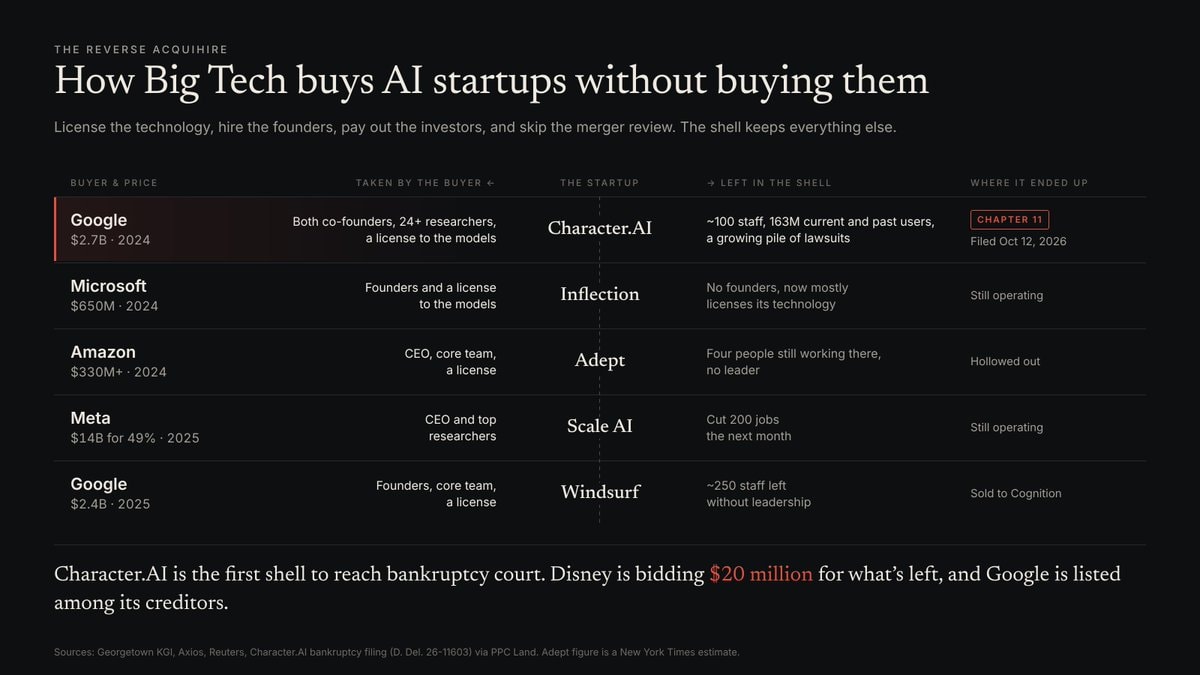
    How Big Tech buys AI startups without buying them

    @tim_officialThis finally exposed the AI industry's dirtiest trick. Google paid $2.7 billion for everything valuable at http://Character.AI, and the 163 million users and the lawsuits stayed behind in the shell that just went bankrupt. Now Disney is buying what's left for $20 million, and Google is listed as one of the creditors. This is the first collapse of a deal structure Big Tech has used all over the AI industry, and I'd be shocked if it's the last. The trick works in four moves: In August 2024, Google paid $2.7 billion for a non-exclusive license to http://Character.AI's models and hired back its co-founders, Noam Shazeer and Daniel De Freitas, along with more than two dozen researchers. On paper, Google NEVER bought the company. Part of that money bought out the venture investors at around a $2.5 billion valuation, up from $1 billion a year earlier. So the investors got paid, the founders went to Google, and Google walked away with the technology. What stayed behind was about 100 employees, a platform with millions of users, and a growing pile of lawsuits. The company no longer had the money to train its own models, so it ran on open-source ones instead. And because the deal was built as a license and a hiring spree instead of an acquisition, it never went through a merger review. The New York Times reported that people involved in these deals cited a desire to sidestep regulatory scrutiny. Then the bill came due: In January, Google and http://Character.AI agreed to settle lawsuits in four states accusing the chatbots of harming minors, including a case tied to a teenager's suicide. In May, Pennsylvania sued over a bot that presented itself as a licensed psychiatrist. Kentucky now shows up in the bankruptcy as a litigation claimant, and the company itself cites potential litigation liabilities as a reason it couldn't keep funding the business. Monday's filing in Delaware puts both its assets and its liabilities somewhere between $50 million and $100 million. Google sits on the list of top unsecured creditors, owed $4,148,944. The filing also counts about 163 million current and past users. The company says they aren't creditors and plans to notify them with a blog post, citing the cost of anything more. The filings don't say what happens to their chats in the sale. Disney's $20 million gets the intellectual property. Last month Disney also hired http://Character.AI's former CEO, Karandeep Anand, as its first CTO. And this setup is spreading across the industry: Microsoft paid $650 million to license Inflection's models and take its founders. Amazon did it with Adept, and four people were left working there. Google did it again with Windsurf for $2.4 billion. Meta paid $14 billion for 49% of Scale AI and took its CEO. So I see ONE business model running through all of it. Big Tech pays the investors, takes the brains, and licenses the technology. The users, the lawsuits, and the bills stay inside a shell with no founders and no money. When that shell fails, a bankruptcy court decides who gets paid, and everyone suing waits in line behind the lawyers and the vendors. The structure is the problem, and it's fixable with one rule: When a tech giant pays to license a startup's technology and hires its founders, regulators should review it as the acquisition it is, and the buyer should inherit the startup's legal liabilities. Until that rule exists, every startup Big Tech licenses this way is a company designed to leave its problems behind.

    ดูโพสต์ต้นฉบับ

    How Big Tech buys AI startups without buying them

    รูปภาพโดย @tim_official· Oct 13, 2026· Google

    เกี่ยวกับรูปนี้

    The image is a dark-themed infographic detailing how Big Tech companies acquire AI startups without full mergers. It presents a table with columns for "BUYER & PRICE," "TAKEN BY THE BUYER," "THE STARTUP," "LEFT IN THE SHELL," and "WHERE IT ENDED UP." The overall mood is informative and analytical, with a clean, modern aesthetic. A notable detail is the red highlight around "CHAPTER 11" for Character.AI, indicating bankruptcy. The text "How Big Tech buys AI startups without buying them" is prominently displayed at the top, followed by the subtitle "License the technology, hire the founders, pay out the investors, and skip the merger review. The shell keeps everything else." Below the table, it states "Character.AI is the first shell to reach bankruptcy court. Disney is bidding $20 million for what's left, and Google is listed among its creditors."

    ดูรูปภาพ Google ทั้งหมดอ่านวิกิ Google

    ?

    รูปภาพ Google เพิ่มเติม

    ดูรูปภาพ Google ทั้งหมด
    Oliver Chang Gemini 4 Neon T3 Code promptOliver Chang Gemini 4 Neon T3 Code promptT3 Code multi-agent team setupT3 Code multi-agent team setupGemini Neon 4 Agent Loops BlueprintGemini Neon 4 Agent Loops BlueprintOpenAI lawsuit and Pachocki AI limitsOpenAI lawsuit and Pachocki AI limitsGoogle Sundar Pichai New Glenn launch2Google Sundar Pichai New Glenn launchKarpo-Decision-31B beats Gemini Decision 1Karpo-Decision-31B beats Gemini Decision 1Google AI cyberattack warning2Google AI cyberattack warningSGLang Consortium foundersSGLang Consortium foundersRussian AI automated cyberattack GoogleRussian AI automated cyberattack GoogleGoogle Amazon Anthropic IPO stake3Google Amazon Anthropic IPO stakeAgent Substrate Google CNCF KubernetesAgent Substrate Google CNCF Kubernetesgrandmother Google search reply3grandmother Google search replyAmazon data push against Google2Amazon data push against GoogleChicago Public Schools vs Google AI2Chicago Public Schools vs Google AIGoogle quantum computing breakthrough2Google quantum computing breakthroughAnthropic IPO valuation Wall StreetAnthropic IPO valuation Wall StreetGemini Memory summary featureGemini Memory summary featureUS stock market gainUS stock market gain